ABOUT & ARCHIVES
Official dossier, audio engineering methodology, and creative archives.
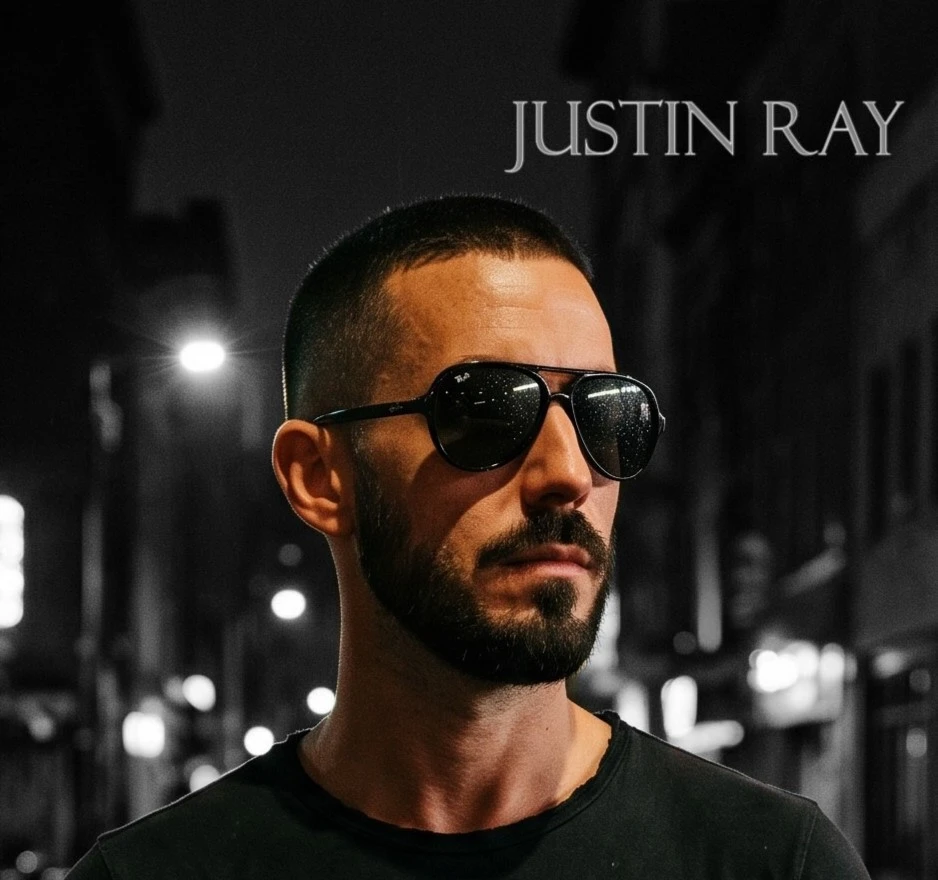
JUSTIN RAY
Music Producer · Audio Engineer · Creative Technologist
Justin Ray is a creative technologist bridging design, audio engineering, and AI, pioneering Hybrid AI Music Production, authoring the Hybrid Production Standard (HPS-1.0), and building browser-native audio engineering tools to keep human creative sovereignty visible in modern music.
The musical foundation began at the piano and the fretboard rather than inside digital code or algorithms. Following a complete withdrawal from social media noise, an intentional discipline was established: composing and recording an original song every single day. That intensive period grounded every subsequent production instinct in harmony, melodic tension, voice leading, and raw emotional resonance.
Growing up surrounded by instruments conditioned the ear to recognize when a harmonic progression resolves too early, when a rhythm feels rushed, or when acoustic air in a room breathes naturally. These psycho-acoustic instincts cannot be programmed into software; they emerge strictly through thousands of hours spent physically playing instruments. This acoustic foundation serves as the essential benchmark against which all generative and digital tools are evaluated.
When generative audio models first entered the industry, the market bifurcated into two unproductive extremes: traditional purists who dismissed the technology outright, and prompt-only operators who accepted unedited AI model exports as finished musical masters. Both perspectives fail to capture the true potential of music creation. Synthetic generations are neither replacements for artists nor finished records: they are versatile raw material.
The hybrid methodology treats raw model outputs exactly like vintage vinyl records or analog field recordings: source material waiting to be sliced, re-synthesized, spectrally corrected, and re-engineered in a Digital Audio Workstation. Through multi-band spectral splitting, stem sanitization, and cryptographic Merkle tree attestation, human producers preserve complete artistic authority over their masters.
Auditioning raw AI audio on precision studio monitors exposes distinct sonic defects: spectral smearing, phase incoherence, synthetic comb filtering, and artificial room resonances baked into frequencies that never inhabited physical space. Dedicated restoration tools like iZotope RX Dialogue Isolation, Spectral Repair, and Music Rebalance act as surgical filters. Stems that cannot survive thorough phase alignment and harmonic filtering are discarded immediately.
This disciplined signal chain bridges live performance and machine generation into a coherent sonic tapestry. Live guitar riffs are resampled into granular pads, neural vocal snippets are pitch-mapped into synthesizers, and real drum kits anchor unpredictable generative textures. Disclosure becomes a badge of craftsmanship rather than a hidden liability.
loserdub ↗
Acoustic Records & Songwriting
Live piano, acoustic guitars, raw vocal takes, and zero generative stems. The pure acoustic control group for the entire production ecosystem.
VISION ↗
Full-Scale Hybrid Releases
Where machine-generated source material and live acoustic performance sit in equal balance with spectral splitting, SLERP interpolation, and DAW mixing.
JRAY ↗
Research & Tool Architecture
The through-line uniting code, research, and sound. Founder of r/hybridproduction, author of HPS-1.0, and developer of browser DSP tools.
Extensive hands-on testing, early model research, and product consulting with leading generative audio institutions:
VOID 1.5 Web Sampler, Granular Slicer & Auto-Mashup Workstation
Free 16-pad performance VOID web sampler, granular slicer, and off-thread Harmonic Auto-Mashup engine running in browser Web Workers.
MIXR Studio
Browser audio mastering suite, 4-band dynamic EQ, harmonic analyzer, and precision limiter.
Artist Finder
12-question diagnostic tool auditing musician discoverability in AI search engines and LLMs.
VISION SYNTH
Polyphonic subtractive Web Audio synthesizer with custom dual oscillators and envelope filters.
J-DAW
Full multi-track Digital Audio Workstation running natively in browser tabs without plugins.
Black Mirror
Interactive audio-reactive visualizer, HTML5 Canvas FFT frequency analysis, and Web MIDI performance portal.
trustnodelogic.web.app
Live web attestation engine generating cryptographic manifests and track provenance certificates.
LAUNCH WEB APP ↗LOOKING FOR HYBRID PRODUCTION OR GEO STRATEGY?
Available for hybrid mixing, creative workflow consultation, audio DSP software engineering, and music AI visibility audits.
Research hub and creative archives curated by Justin Ray for Hybrid AI Music Production.
Official technical dossier authored by Trust Node Logic.